AI Won’t Replace Case Managers, But It Can Make Them Superhuman
Few professions rely more on human connection than case management.
Whether working in homelessness services, behavioral health, child welfare, workforce development, or community outreach, case managers do far more than complete paperwork. They build trust, navigate complex systems, advocate for clients, and help people through some of the most difficult moments of their lives.
Yet much of a case manager’s day isn’t spent with people.
It’s spent documenting visits, searching for resources, updating databases, preparing reports, scheduling appointments, and responding to emails.
Artificial intelligence can’t replace the empathy, judgment, and relationships that define effective case management. But it can dramatically reduce the administrative burden that keeps professionals behind a computer instead of in front of the people they serve.
The future isn’t AI instead of case managers.
It’s AI making case managers more effective.
The Administrative Burden Is Real
Studies consistently show that human service professionals spend a significant portion of their day on documentation and administrative tasks. Every required note, assessment, referral, and follow-up serves an important purpose—but together they can consume hours that could otherwise be spent helping clients.
When organizations ask why staff are burned out or why caseloads feel unmanageable, the answer often isn’t the people. It’s the paperwork.
Reducing administrative work doesn’t just improve productivity. It can improve employee retention, reduce burnout, and create better experiences for clients.
Where AI in Case Management Can Help Today
Contrary to popular belief, AI doesn’t need to make decisions about clients to be valuable. Some of its greatest strengths are in handling repetitive tasks that consume valuable staff time.
Examples include:
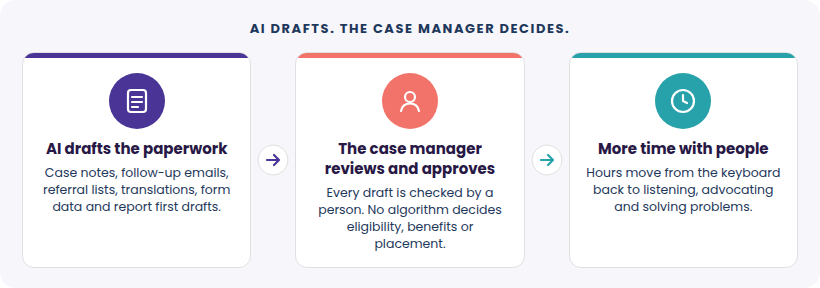
- Summarizing meeting notes into case records.
- Drafting follow-up emails after appointments.
- Creating referral lists based on client needs.
- Translating documents into multiple languages.
- Searching policies and procedures in seconds.
- Extracting information from uploaded forms.
- Generating first drafts of grant or compliance reports.
In each case, the case manager reviews and approves the work. AI accelerates the process — it doesn’t replace professional judgment.
Helping Staff Find Information Faster
Every nonprofit has institutional knowledge hidden in documents, emails, policies, and shared drives. Finding the right form or remembering the latest eligibility requirements can take far longer than it should.
AI-powered search tools can help staff ask natural-language questions like: “What documentation is required for emergency rental assistance?”
or
“Which workforce program serves veterans over age 55?”
Instead of digging through folders, staff receive answers in seconds, saving time and reducing errors.
Smarter Documentation, Better Client Care
Documentation is essential for continuity of care, compliance, and funding. But no client wants to spend half their appointment watching a case manager type.
With appropriate safeguards, AI can help draft case notes from meeting summaries, organize information into standardized formats, and flag missing documentation before records are submitted.
The result is more complete records and more meaningful conversations with clients.
AI Can Spot Patterns Humans Might Miss
One of AI’s greatest strengths is recognizing trends across large amounts of information.
Imagine a housing nonprofit serving thousands of families. An AI system might identify that clients who miss two appointments and report transportation barriers are significantly more likely to exit the program before obtaining housing.
Rather than waiting for someone to fall through the cracks, staff can intervene earlier with transportation assistance or additional outreach.
This isn’t replacing professional judgment — it’s providing another tool to support it.
Ethical AI Requires Human Oversight
The promise of AI comes with responsibility.
Organizations should never allow algorithms to make final decisions about eligibility, benefits, housing placement, or client services without human review.
Human services involve nuance that data alone cannot capture.
Responsible AI should always be:
- Transparent
- Explainable
- Fair
- Secure
- Subject to human oversight
Clients deserve to know when AI is being used and how their information is protected.
Trust remains the foundation of effective case management.
Protecting Client Privacy
Because nonprofits often work with sensitive information, privacy must be part of every AI conversation. Before adopting any AI platform, organizations should ask:
- Where is client data stored?
- Is information used to train future AI models?
- Does the platform comply with applicable privacy requirements?
- Who has access to generated content?
- Can sensitive information be removed before processing?
Strong governance is just as important as strong technology.
AI Is Also Helping Managers
AI doesn’t only benefit frontline staff. Supervisors can use AI to:
- Identify workload imbalances.
- Monitor documentation completion.
- Track program performance.
- Summarize trends across hundreds of cases.
- Forecast staffing needs.
- Generate reports for funders and boards.
Instead of spending days compiling data, leaders can focus on improving programs and supporting employees.
The Skills That Matter Most Aren’t Technical
As AI becomes more common, the most valuable skills for case managers won’t be coding or programming. They’ll be the skills that have always mattered:
- Empathy
- Critical thinking
- Ethical judgment
- Communication
- Cultural competency
- Relationship building
These are qualities machines cannot replicate. Technology can process information. People build trust.
Start Small
Organizations don’t need an enterprise AI platform to begin seeing benefits. Start with one repetitive task:
- Drafting meeting summaries.
- Organizing case notes.
- Searching policy documents.
- Translating informational materials.
- Creating routine correspondence.
Measure the time saved. Ask staff what worked. Expand gradually while maintaining clear policies and human oversight.
Successful AI adoption is less about buying technology and more about improving workflows.
Artificial intelligence is changing how nonprofits operate, but it shouldn’t change why they exist.
The mission remains helping people. The opportunity is to remove administrative barriers that keep skilled professionals from doing their best work.
The organizations that succeed won’t be the ones that automate the most tasks. They’ll be the ones that use AI thoughtfully — enhancing human expertise rather than replacing it.
When technology gives case managers more time to listen, advocate, and solve problems, everyone benefits. And that’s the kind of innovation worth pursuing.
Ready to turn your data into smarter decisions? Data Love helps nonprofits transform information into meaningful insights through data strategy, analytics and visualization. Contact us to learn how better data can strengthen your mission and amplify your impact.
Start small today. Ask Dorothy at datalove.ai one question you would normally spend twenty minutes searching for, like “What are the eligibility requirements for emergency rental assistance in Colorado?” and see how much of your afternoon comes back.